Consumer Sports Tech Is Having Its Square Moment
Saturday, January 31, 2026, at 12:55PM
By Eric Richardson
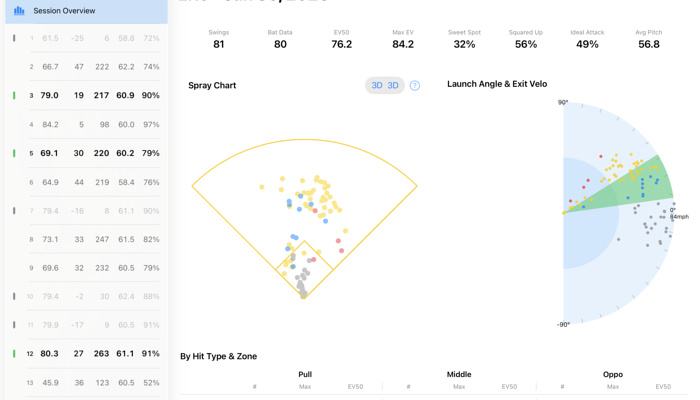
My CageStats app pulls together data from Rapsodo and Blast Motion to give a view of a swing with both "inputs" and "outputs."
People used to ask if I had hobbies. My answer was no—I have kids. But with the boys now 9 and 11, I've picked up something I can justify as kid-adjacent: consumer sports tech, specifically baseball.
The youth sports industry is booming right now (in good and bad ways, but that's a different story), and throughout it you're seeing technology that was once inapproachably expensive become a part of home setups and how young athletes train.
The edges of this space feel very much like the world in which Square first released its "little white card reader." Consumers suddenly had a computer in their pocket, and Jack and team saw the chance to use that to revolutionize how businesses could get paid.
s for me, we put a batting cage in the backyard, and hitting sessions now involve a Rapsodo Pro 2.0 launch monitor and a Blast Motion bat sensor, along with a couple phones and iPads. I couldn't help trying to make those pieces fit together.
For those not in the weeds of all of this, the Rapsodo Pro 2.0 is an example of a launch monitor. It contains camera and radar to observe the flight of the baseball. For pitching, that gives you amazing data on release points, spin rates, and velocity. For batting, it tracks similar details as the ball leaves the bat after contact. This tech is much more common in the golf world, where launch monitors are at the core of simulator setups. It's the same idea for baseball. The launch monitor is observing exit velocity, exit direction, launch angle, spin characteristics, etc. These are the outputs of the baseball swing.
The Blast Motion bat sensor is a tiny device that you slip onto the knob of the bat. It is an "inertial measurement unit," meaning that it can understand how it moves through space. Using clever math, it turns that into an understanding of the path of a baseball bat from the batting stance to and through the point of contact. From Blast Motion you get what I think of as the inputs to a baseball swing: bat speed, attack angle, rotational acceleration, and a variety of metrics on angles and planes.
My basic question starting out was how you could marry these input and output ideas to get a more complete view of a swing. Rapsodo and Blast both have apps and websites, so could I access both data sets and match them up to create one view? This also presented an excuse to dip my toe back into iOS development, first more manually and more recently with a heavy dose of AI.
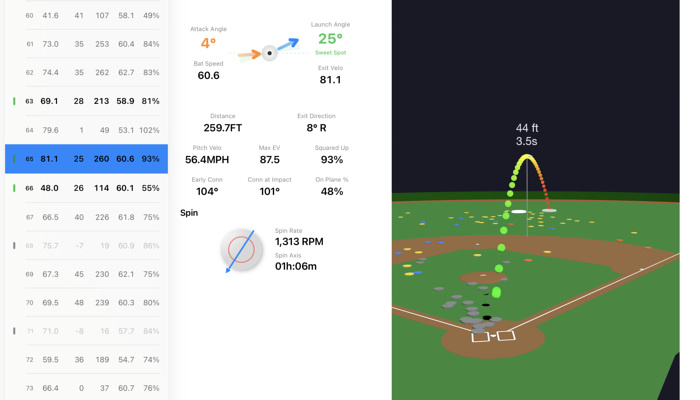
In a CageStats swing view, you can see how inputs connect to outputs, as well as use the data we've recorded to visualize a trajectory path for the ball. I let Claude learn the physics here, not me.
This visual represents sort of the core of what I first set out to see: how does the input bat data connect to the output launch data? MLB StatCast gives a number of definitions that become useful here: the Ideal Attack Angle range is 5-20°; the Launch Angle Sweet-Spot is 8-32°. From a coaching perspective, the idea that you're trying to teach is that the best swing matches the trajectory of the incoming pitch, which will naturally be coming down some as it travels toward the plate. Matching that trajectory gives you the most time where the bat and the ball are on the same plane, and the most chance of direct solid contact on the hit.
Via the combined data, you can compute a really interesting metric, the Squared-Up Rate. From StatCast, this is "How much exit velocity was obtained compared to the maximum possible exit velocity available, given the speed of the swing and pitch." So pitch speed (Rapsodo) and bat speed (Blast) give you a theoretical max exit velocity, and you can look at actual exit velocity (Rapsodo) to figure out what percentage of the potential was achieved on the swing.
As for the boys, they tolerate my interests. When they have friends over to hit they enjoy watching each others' calculated distances in the Rapsodo app. They nod respectfully when I show them session rates for attack and launch angles after the fact. They pay attention when I scrub through videos comparing how their hips fire on a good swing vs a great swing.
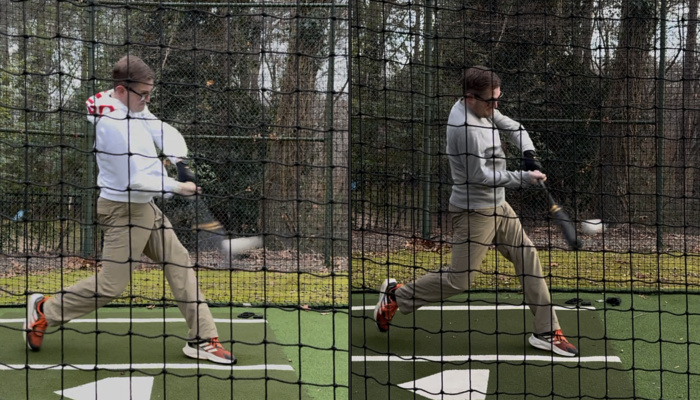
SwingScrubber is a little app I built to take a video of a hitting session, allow the easy tagging of swing contact points, and then a way to compare two synchronized swings.
Honestly, I pretend this is all for them, but I played through high school and can totally see myself joining an old-man league in a decade when we're empty nesters. Don't ask how many more swings I've taken out there compared to them.
This is obviously just a tiny taste of the data-based approach to training pioneered by folks like Driveline, but it's also very much in the vein of what they're doing. The Rapsodo is still a relatively expensive piece of kit, but it's not actually that crazy in a world where youth two-piece composite bats at $500 a pop are lining every dugout fence, and it's not going to be that long until you get the same data off of an iPhone.
Plenty of apps—including Blast's—are out there trying to use the iPhone camera to act as a launch monitor. They aren't nearly as good as the Rapsodo yet, but the sensors will continue to get better.
The real explosion in this space is around AI, doing automated analysis of video to produce coaching tips, cut highlight packages from game film, and so forth. You name it, someone's out playing with it right now. SwingAI from WinReality (who bought Blast Motion in 2025), is a great example, though personally I'm not sure I'll ever be able to convince it that my Torso Load is great enough.
WinReality's TrainVR is also an amazing example of what becomes possible as VR headsets advance. Right now the Meta Quest 3s it uses is ok, not great, but I love the idea that this can give my 11 year old a way to train the recognition of what a curveball looks like before he'll ever see a high quantity of them in a game.
So if I start posting here about sports tech, it's not that I've quit moving money as a day job. I've just picked up a hobby, and am so interested to see where this moment takes us and what kind of innovation comes next.